
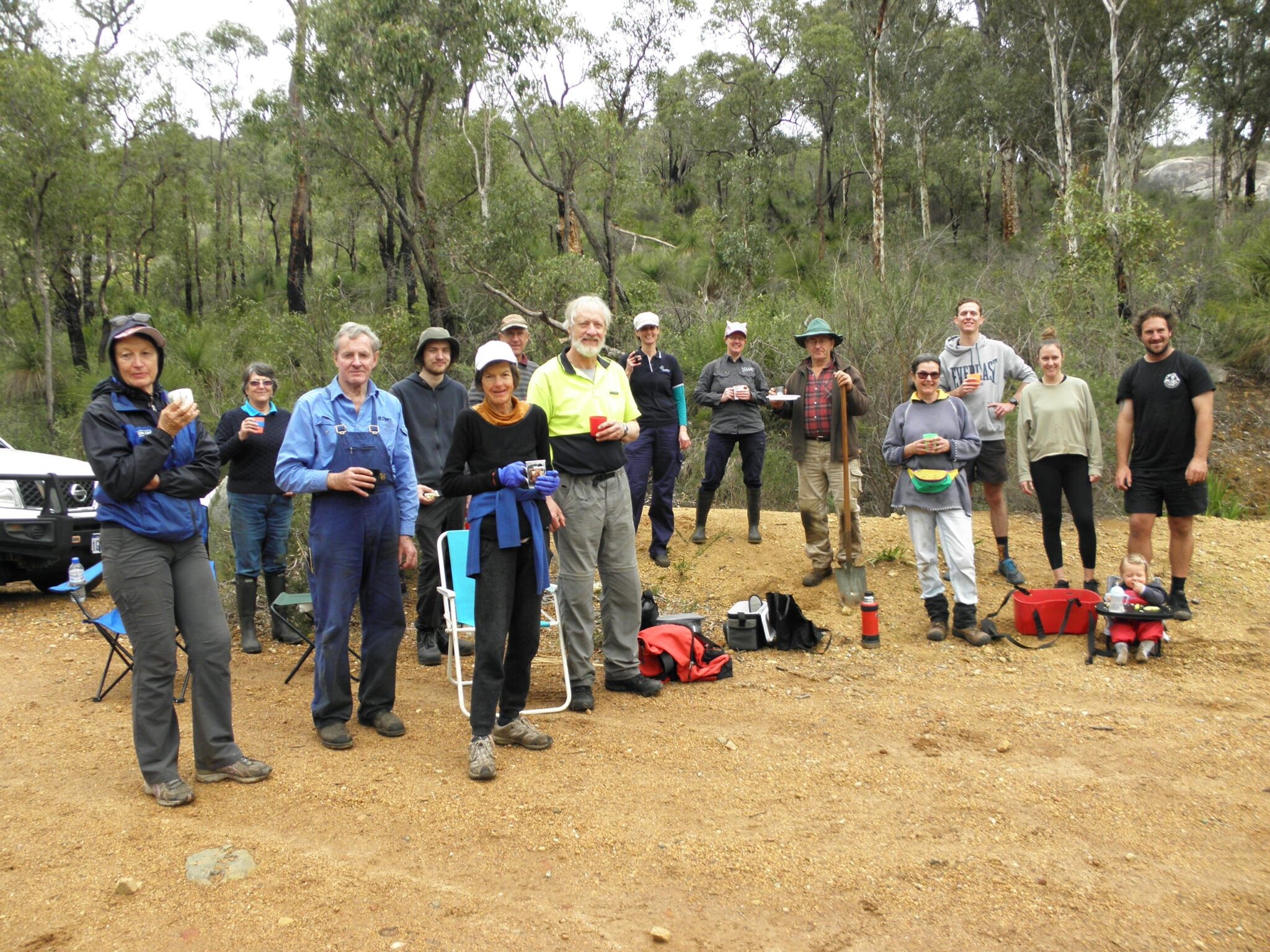
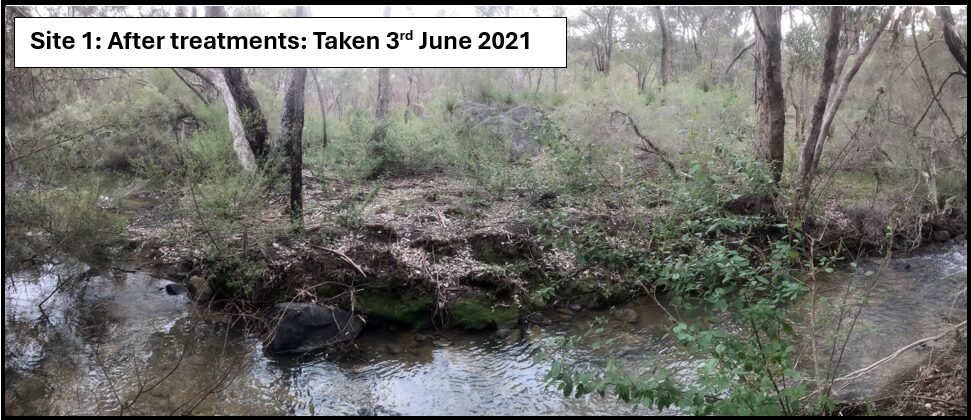
The location of the earlier project was at the confluence of Piesse Brook with the Helena River. The banks and floodplain of the river supported a dense cover of Watsonia, now removed. A follow-up planting activity of seedlings grown from seed collected in the National Park, as well as secondary succession of endemic species has resulted in a far more natural assemblage of plant life, and presumably the native fauna that depend upon it. The Wiry Wattle (Acacia extensa) and the Karri Hazel (Trymalium odoratissimum) are the two most common species amongst the natural regrowth.
A sampling site is shown below:

The aim of the 2024 – 2026 Community Rivercare Project 2 was to clear remaining Watsonia and blackberry as far as the embankment of a bridge where Victor Road crosses the Helena River. We saw this embankment as a partial barrier to re-invasion. The project began in early November of 2024, quite late in the season, when the Watsonia were beginning to show signs of entering dormancy. We were becoming increasingly concerned that time was running out. The initial spraying by the contractor had to be delayed until water flow in the river and brook had ceased, since both water sources contribute to the inflow of water into the Lower Helena Pump Back Dam. Water from this dam is pumped to Mundaring Weir. Understandably, the Water Corporation demanded spraying would not commence until the flow had stopped.
While the spraying took place over two days, a Friends Group member was able to do maintenance spraying on the Rivercare Site 1, as well as further upstream along the brook.
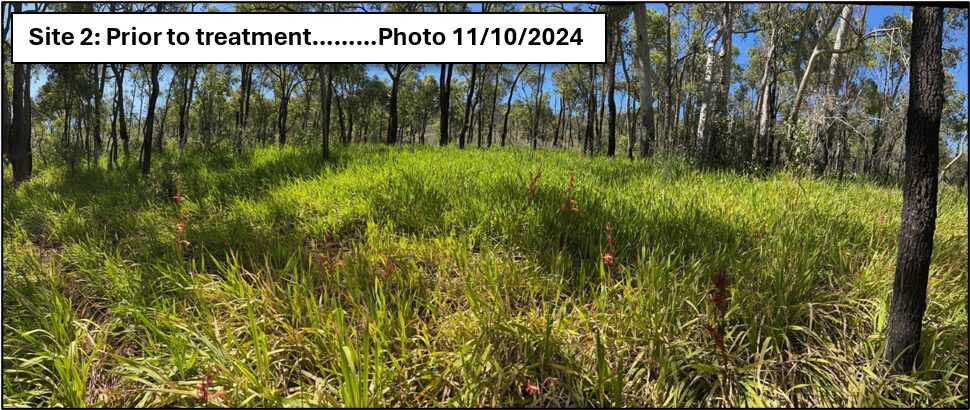
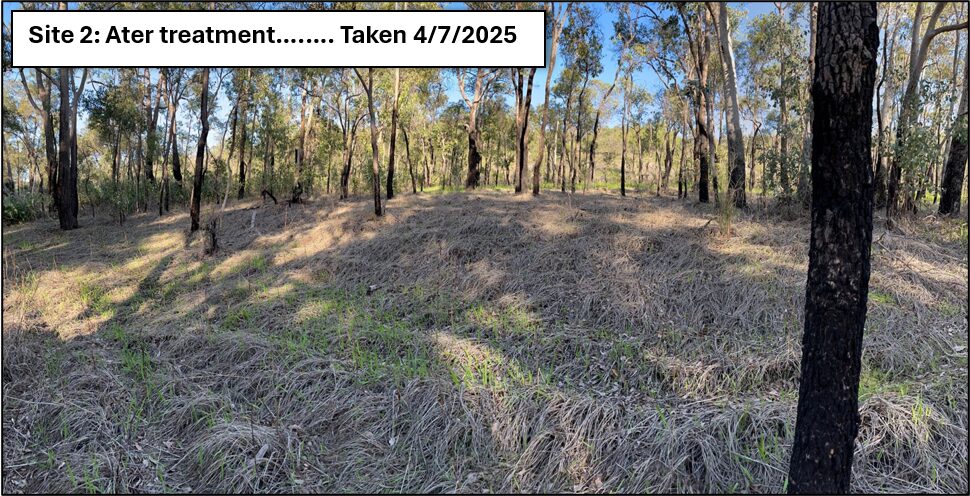
Despite the late spraying, the impact on the Watsonia and blackberry was enormous. During July and August of this year, very little regrowth of these weeds was apparent.
A sampling site is shown below:
The contractor will be employed to do follow-up spraying during October/November of 2026, once the water flow has ceased. From then on, the Friends of Piesse Brook will continue with maintenance spraying into the future.
The planting activity carried out in 2020 had not been as successful as we had hoped, with only 31% survival of seedlings. We decided for the second project that we would rely upon natural regeneration that had shown to occur in Project 1. If this does not happen, a future project application might be considered to grow and plant seedlings, using local provenance seed collected within the National Park under an already acquired license through DBCA and grown in a sophisticated facility owned by a member of the Group.
What a privilege it has been to be involved in making such a difference. If you too would like to make a difference, please join us by contacting the City of Kalamunda on 9257 9999 or follow this link: https://www.kalamunda.wa.gov.au/ourcity/environment/programs/friends-group